
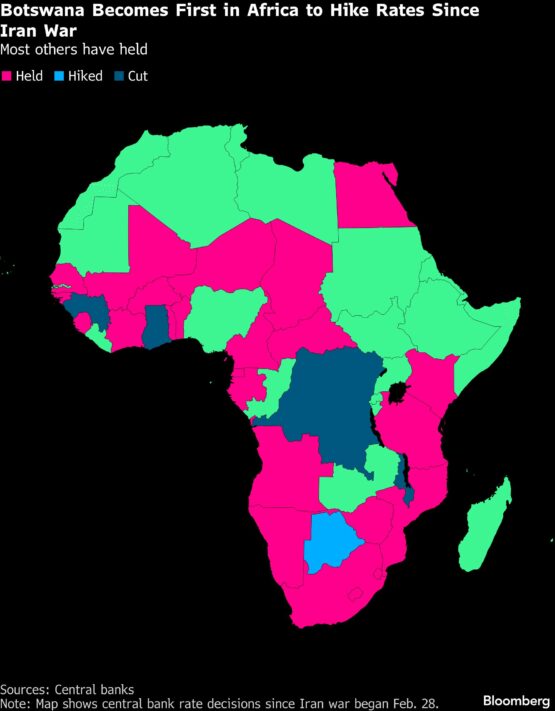
Botswana became the first African central bank to raise interest rates after the Iran war triggered a global energy shock, with inflation seen more than doubling this month.
The monetary policy committee lifted the key rate to 5.5% from 3.5% Governor Lesego Moseki told reporters at a briefing in the capital, Gaborone, on Thursday.
ADVERTISEMENT
CONTINUE READING BELOW
ADVERTISEMENT:
CONTINUE READING BELOW
“The MPC expects inflation to increase significantly in the short term and breach the upper band of the objective range of 3% to 6% in the second quarter due to the recent increases in fuel prices, public transport fares and medical aid premiums,” he said. “Inflation is expected to average 8.7% in 2026, then decline to 5.6% in 2027.”
There’s a risk inflation may exceed forecasts as second-round effects from fuel and administered prices, including electricity and transport fares, feed through, he added.
The US-Israel war on Iran that began Feb. 28 has led to a surge in food, fertiliser, and energy costs because of the closure of the Strait of Hormuz – a transit point for at least a fifth of the world’s seaborne oil and liquefied gas and a significant share of key crop nutrients. Governments across the world have responded by reversing course on monetary policy, capping energy prices and cutting fuel taxes.
Higher fuel prices will “substantially” impact Botswana’s inflation this year because of the large weight of transport in the gauge used to calculate the consumer price index – one of the highest on the continent – Oxford Economics said in a research note on April 15.
The central bank expects inflation to shoot up to 8.9% this month because of the war in Iran from 4.2% in March, Innocent Molalapata, an official at the central bank, said. That level would be the highest in three years.
For countries like Botswana – where the economy is already under strain from one of the worst downturns in the diamond industry, which accounts for about 80% of exports and a third of government revenue – the war is bringing further pressure to bear.
The southern African nation is also grappling with a foot-and-mouth disease outbreak. Beef exports to the European Union – a key market – have been restricted following the outbreak.
The outbreak “with associated livestock movement and slaughter restrictions may lead to higher food inflation,” the governor said.
© 2026 Bloomberg
#Botswana #Africa #hike #rates #war