
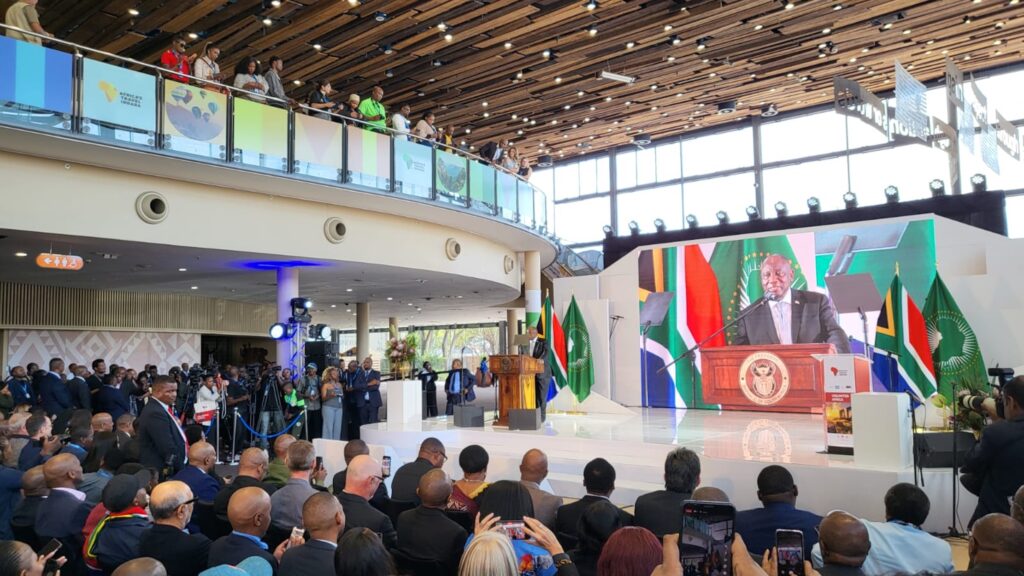
South Africa welcomed a record 10.5 million international tourists last year – and President Cyril Ramaphosa hailed the double-digit growth as “a clear sign that the world is rediscovering [the] country with renewed enthusiasm” in his keynote address opening Africa’s Travel Indaba (ATI) in Durban on Tuesday.
“As we look to the future, we must continue to diversify our [tourism] source markets… We are strengthening our presence in China, India, Southeast Asia, Mexico and Brazil, all countries and regions with rapidly growing outbound travel markets,” he said.
Read/listen:
Travel Indaba 2026 to spotlight Africa’s tourism potential
De Lille talks tourism: The boom, African market and tackling xenophobia
Iconic Hilton Durban shuts after hotel group yanks agreement
Ramaphosa highlighted the success of SA hosting the G20 Leaders Summit in Johannesburg last year and the importance of Global South countries that have huge populations, burgeoning middle class and upwardly mobile citizens that are looking to travel internationally.
“During our G20 Presidency, we championed the priorities of the Global South, including sustainable tourism, infrastructure investment and equitable growth. The G20 year allowed us to pilot the Electronic Travel Authorisation system, which is now being rolled out to simplify travel for millions of visitors,” he said.
Tourism-related reforms
Ramaphosa said it is “one of several reforms that are making South Africa and the continent more accessible, more competitive and more welcoming”.
He highlighted the importance of increasing air connectivity both within Africa and with Asia and South America. “Tourism cannot grow without connectivity. In South Africa and across the region, we have seen an increase in airline seat capacity over the last year.”
“This growth has been driven primarily by African and Asian routes, reflecting the rising demand for travel to our region,” the president said at the continent’s biggest annual travel trade show at Durban’s Inkosi Albert Luthuli International Convention Centre (ICC).
ADVERTISEMENT
CONTINUE READING BELOW
“These developments are part of a broader continental movement, a recognition that Africa’s future lies in being connected to itself and to the world…
“Our new visa reforms, including the Electronic Traveller Authorisation system and the Digital Nomad Visa, are designed to make travel easier and more seamless,” added Ramaphosa.
Listen/read:
SA tourism policy is economic policy
Chinese and Indian visitor numbers slump despite visa reforms
Unlocking the future of African tourism
“As we open Africa’s Travel Indaba 2026, we do so with a sense of pride. We take pride in the resilience of the tourism sector,” he said earlier in his speech.
“We take pride in the partnerships that have carried us through some of the most challenging years the global tourism industry has faced.”
Speaking ahead of Ramaphosa’s main address, Tourism Minister Patricia de Lille said at ATI that the SA tourism sector has now surpassed the growth seen prior to the Covid-19 pandemic, recovering from the lockdown lows.
Both De Lille and Ramaphosa highlighted that most of SA’s international tourists hail from the rest of Africa.
“It is significant that three-quarters of international arrivals come from the SADC [Southern African Development Community] region. This tells us something important: Africans are choosing Africa,” said Ramaphosa.
Read/listen:
More chaos at SA Tourism – and it’s showing up in the arrivals figures
SA Tourism needs stability, not political interference
“That is why South Africa is working with our neighbours to advance the SADC Tourism UniVisa, which would enable seamless, borderless travel for tourists across SADC member states,” he said.
ADVERTISEMENT:
CONTINUE READING BELOW
“We are also working to expand our one-stop border posts and develop cross-border itineraries that showcase the richness of our region. When Africans travel within Africa, we strengthen our economies, deepen our cultural ties and build a more integrated continent,” he added.
No comment on xenophobia
But Ramaphosa avoided any specific mention of recent anti-immigrant protests in Durban, Johannesburg, Pretoria and the Eastern Cape – many of which were seen as xenophobic, with some of these turning violent.
The ICC in Durban had a stronger police presence and security fencing around the centre on Tuesday, as the eThekwini metro took extra precautions this year with Ramaphosa opening the event and several tourism ministers from Africa attending the trade show.
There was a small anti-xenophobia protest on the ICC Arena side of centre, but that was after Ramaphosa had left and was closely monitored by the police.
Listen to SA’s Tourism Minister speaking on The Property Pod, ahead of the Travel Indaba:
You can also listen to this podcast on iono.fm here.
#South #Africa #Global #South #tourists