
Some of the most important business decisions are not made in boardrooms. They are made in rooms most of us will never see, on calendars that do not show up in earnings calls.
For three years, the US semiconductor industry has been walking a tightrope. Washington keeps tightening the rules on what kind of chips can be sold to China. Beijing keeps making clear it will spend whatever it takes to build its own. American chip CEOs are stuck in the middle, trying to keep both customers and lawmakers happy at the same time.
I have watched this stalemate long enough to know the loudest moves rarely matter most. The summits, the press conferences, the export-control press releases all generate headlines. The deals that actually shift the industry tend to be much quieter.
Which is why one meeting on May 18 in Beijing has Wall Street paying close attention.
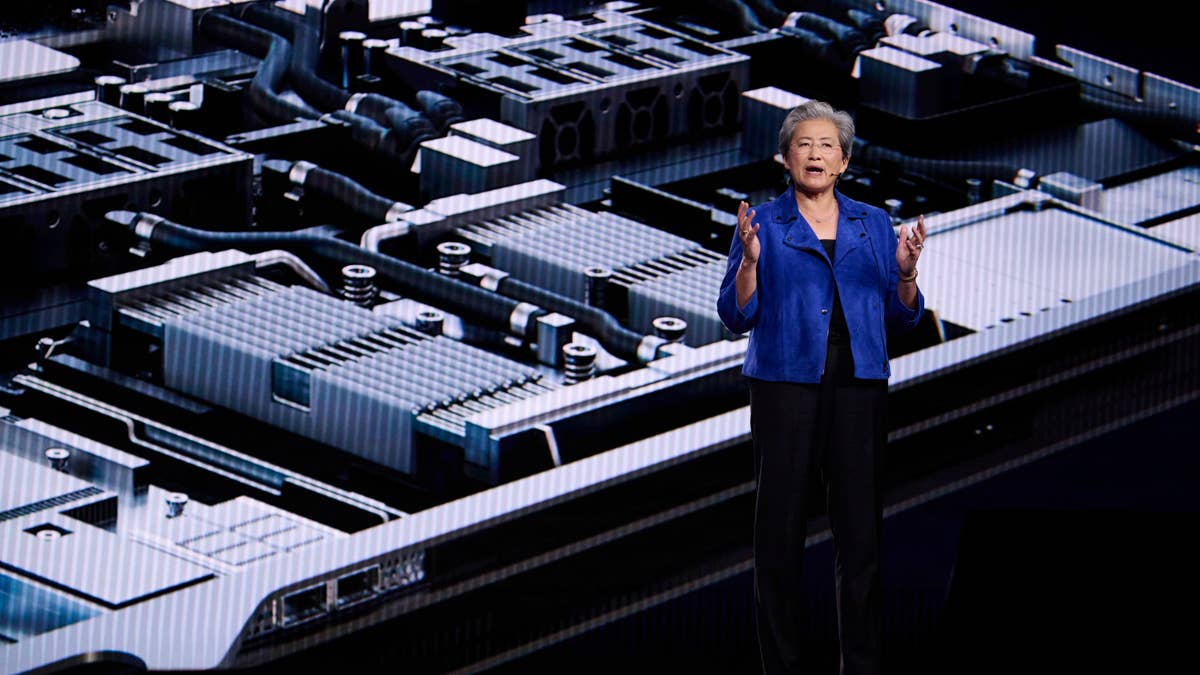
Advanced Micro Devices (AMD) Chief Executive Lisa Su sat down with Chinese Vice Premier He Lifeng at the Great Hall of the People, just two days after President Donald Trump wrapped his state visit to China.
Bloomberg / Getty Images
What Lisa Su promised China’s vice premier in Beijing
He Lifeng invited Su and other multinationals to “seize the opportunities presented by China’s development and deepen mutually beneficial cooperation,” according to a readout from CGTN. He framed the meeting as a direct extension of the consensus reached between Xi Jinping and Trump the week before.
Su responded by reaffirming AMD’s commitment to expanding its operations and investment in the country, reported Investing.com.
The visit had a quiet weight to it. Su was not part of the 17-executive delegation that flew in with Trump, a fact that did not go unnoticed in Beijing.
Su was “catching up on missed homework,” Peng Peng, executive chairman of the Guangdong Society of Reform, told the South China Morning Post.
Related: AMD and Intel lead 2026 gains as AI guard changes
The morning after the Beijing meeting, Su was on stage at AMD’s AI Developer Day in Shanghai. China is “the world’s most dynamic AI ecosystem,” she told the audience, according to Benzinga.
That language is not throwaway. China accounts for roughly one-quarter of AMD’s annual revenue, Benzinga reported. Walk away from that base, and AMD’s growth story breaks.
Why AMD chip sales to China are suddenly back in play
When I lined up the timeline of Su’s solo trip against the delegation that traveled with Trump, two things stood out. She moved within days of the summit. And she did it without political cover.
That solo profile is what changes the calculus. Analysts read the meeting as a signal Washington is preparing to let select Chinese buyers back in for higher-end AI chips, according to the South China Morning Post.
“The US appears to be pulling back on its aggressive tariff war and tech decoupling,” Peng said.
AMD’s current Chinese product lineup tells the story of that fight. The chipmaker has spent two years engineering modified, less powerful accelerators specifically to comply with US rules.
Where AMD stands on China chip exports today:
- The MI308 accelerator can ship to China without special government approval.
- The MI325X, AMD’s higher-end accelerator, moved from “presumption of denial” to a case-by-case review process in January 2026.
- Nvidia (NVDA) received clearance for roughly 10 Chinese companies to buy its H200 processors, though no chips have shipped yet.
- Congress is advancing the MATCH Act, which would push Japan and the Netherlands to align their chip export rules with US rules within 150 days.
Source: The Next Web
Beijing has watched this slow squeeze and started building its own way out. Chinese buyers are now accelerating adoption of Huawei accelerators and other domestic alternatives, Benzinga reported.
Every quarter AMD waits for an export-control thaw is a quarter Huawei takes another bite of the AI hardware base AMD spent a decade building.
What Lisa Su’s Beijing bet means for AMD investors
This is the part of the story that touches your portfolio.
AMD shares slipped roughly 6% on May 19 even after the meeting news, GuruFocus reported. The stock currently trades at a price-to-earnings ratio above 130, well into premium-tech territory, where any policy disappointment gets punished fast.
Wall Street, meanwhile, is splitting the difference. Citi raised its AMD price target to $460 from $358 on May 18, while keeping a neutral rating, Benzinga reported. Citi analyst Atif Malik cited what he called a “CPU renaissance” driven by AI workloads, with the server CPU market alone potentially growing to $132 billion by 2030. Evercore ISI lifted its target to $579 on May 19 with an Outperform rating, Benzinga reported.
Then there is the rumor that may already be moving the stock more than the China headlines. Industry discussions suggest AMD has secured Anthropic as a customer for its next-generation MI450 AI accelerators, with a formal announcement possibly coming at AMD’s Advancing AI event in July, Benzinga reported.
My read, after pulling Citi’s note and AMD’s last earnings setup side by side, is that Su’s Beijing trip was not a trade-show handshake. It was a hedge. If Washington loosens the rules later this year, AMD wants to be the first US chipmaker through the door. If it does not, Su will have at least bought herself a Beijing relationship her rivals don’t have.
The August 4 earnings report, with Street estimates pointing to $11.28 billion in revenue, will tell us whether words from this trip start turning into orders.
Either way, every other US chipmaker now has to decide whether to follow her in.
Related: AMD buys $6.5 million of surging tech stock
#Lisa #making #bold #bet #chipmakers #can039t #ignore