
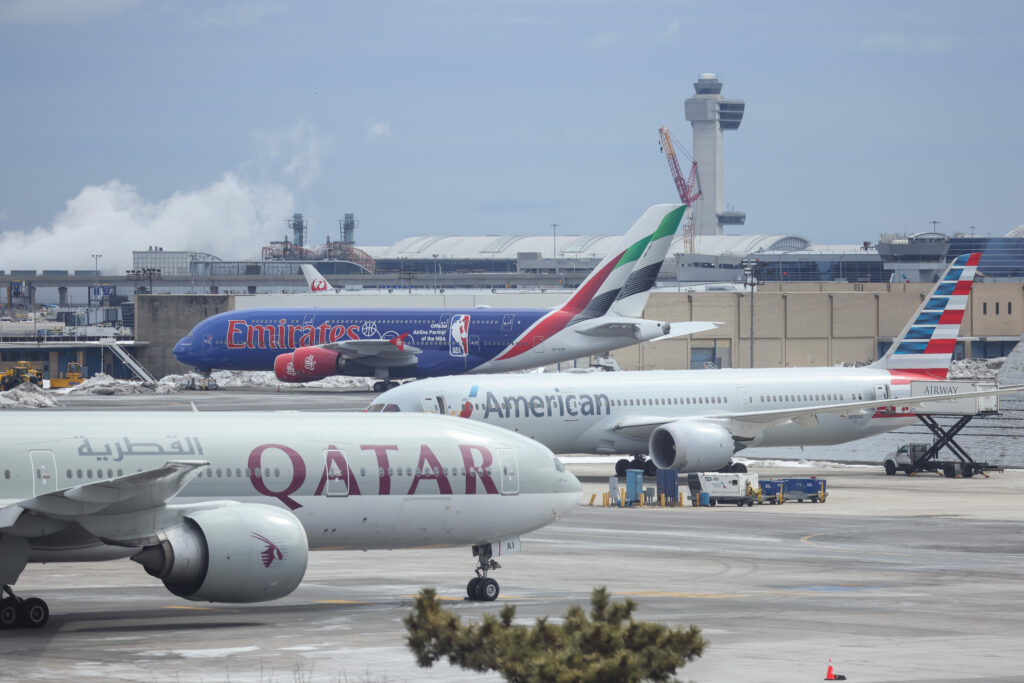
David Farelo was barely out of Doha on a Geneva-bound flight on Saturday when the plane suddenly descended to 25 000 feet then made a brisk U-turn and returned to the airport.
Once back on the ground, it soon became clear why. Missiles fired from Iran started to light up the sky. Some of them were intercepted, others exploded nearby.
Read:
Airline cancellations exceed 15 000 as Iran war enters fifth day
Here are the airports and airlines disrupted by US-Iran conflict
“We started looking for an exit point,” says Farelo, who is CEO of Currency Hub.
“Then we found out Dubai airport had been hit. Alerts started coming through on everyone’s phones and the authorities told us they would put us in hotels. I checked on Twitter [X] to see what was going on and I could see it was not de-escalating. I decided we had to find a way out of the country to avoid the herd.”
British Airways staff were on their way to Saudi Arabia by road, so Farelo and his colleague decided to do the same.
After some panicked phone calls, a driver arrived to ferry them to the Saudi Arabian border.
By 6pm on Sunday they had arrived in Riyadh and boarded a plane for London. Just 45 minutes later, Saudi airspace was shut down.
‘Hundreds of thousands’ trapped
Tourism consultant Gillian Saunders says the latest crisis in the Middle East has trapped hundreds of thousands of people in Doha and Dubai – the busiest airport in the world.
The three major airlines in the region – Emirates, Etihad and Qatar Airways – handle 90 000 transit passengers a day, not counting those travelling to and from the UAE for tourism and business.
ADVERTISEMENT
CONTINUE READING BELOW
“People are now nervous about travelling,” says Saunders. “Many are postponing travel arrangements.”
There are 14 daily flights by Qatar, Emirates and Etihad serving Johannesburg, Cape Town and Durban. That’s roughly 4 200 passengers daily now unable to depart from or return to SA, says Otto de Vries, CEO of the Association of Southern African Travel Agents (Asata), which represents about 95% of the SA travel agency market.
The three Gulf-based airlines have become a major link to the outside world for South Africans, so disruptions to normal flight schedules will have a major impact on travel to and from SA.
Then there’s the likelihood of increased air fares due to increased oil prices which jumped from $70 to $80 a barrel in the last few days and airlines having to reroute around the conflict zone – at higher cost.
“Many South Africans are transiting through the UAE so they will be stranded in other parts of the world, and finding alternative routes is not easy,” says De Vries. “It’s difficult to know how bad the situation is at this stage as our members are trying to assist their clients in their travel arrangements. The longer the conflict goes on, the bigger the impact will become.”
UAE authorities assisted more than 20 000 travellers on Saturday alone, a figure that is growing by the day. Limited flights for repatriation and evacuation were expected to commence early in the week. The UK has more than 100 000 citizens registered in the area, and is making evacuation plans for tens of thousands according to one report.
“Cape Town Tourism is aware of the current global flight disruptions linked to the situation in the Middle East and related airspace closures,” says Enver Duminy, CEO of Cape Town Tourism. “We strongly encourage travellers to check directly with their airline or travel agent before heading to the airport, as delays and cancellations are likely.”
There’s little question that this latest conflict damages confidence in the UAE as a tourism and business hub. The only uncertainty is around the duration of the conflict.
Recovery time
It took Egypt more than three years to recover from the 2015 bombing of Metrojet Flight 9268 which killed 224 passengers, mostly Russian, over the Sinai.
ADVERTISEMENT:
CONTINUE READING BELOW
According to the 2019 Tourism Disaster Recovery Report, which analysed 90 tourism crises, recovery times are getting shorter – though political instability has the greatest impact on the sector.
Doha and Dubai had positioned themselves as islands of stability in a volatile part of the world, making them attractive destinations for expats, investors and tourists.
The US has now cautioned Americans to reconsider travel plans to the area, while the UK advised against “all but essential” travel to the UAE.
Dubai’s international airport processes more than 95 million passengers a year. This is expected to suffer heavily following the events of the past few days.
High-spending Westerners and Asians may divert travel to alternative destinations like Singapore, Bangkok, Istanbul or Europe, according to The Traveler.
Cinzia Bianco of the European Council on Foreign Relations says the missile bombardment is “Dubai’s ultimate nightmare,” with “no going back” to the prior perception of the emirate being insulated from regional volatility.
On the upside, if the conflict is short-lived, a relatively quick rebound can be expected. Gulf tourism has shown reliance following previous crises, such as the 2022 missile attacks on Israeli-linked shipping by the Houthis.
Read/listen: Airlines brace for prolonged Middle East airspace crisis
Listen to Jeremy Maggs’s interview with Plane Talking MD Linden Birns in this Moneyweb@Midday podcast (or read the transcript here):
#Middle #East #aviation #crisis #traps #thousands #South #Africans