
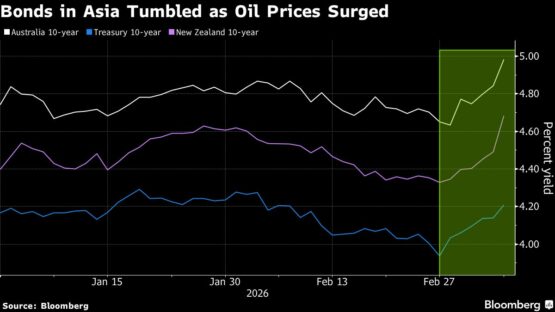
Global bond markets tumbled in Asian trading Monday as an oil price shock prompted investors to price in higher inflation and a deteriorating economic growth outlook.
Yields on benchmark 10-year US Treasuries rose more than seven basis points — the most since January — with pressure rippling through other sovereign debt markets. Australia’s policy-sensitive three-year yield climbed to its highest level since 2011, while German bund futures slid to an almost 15-year low.
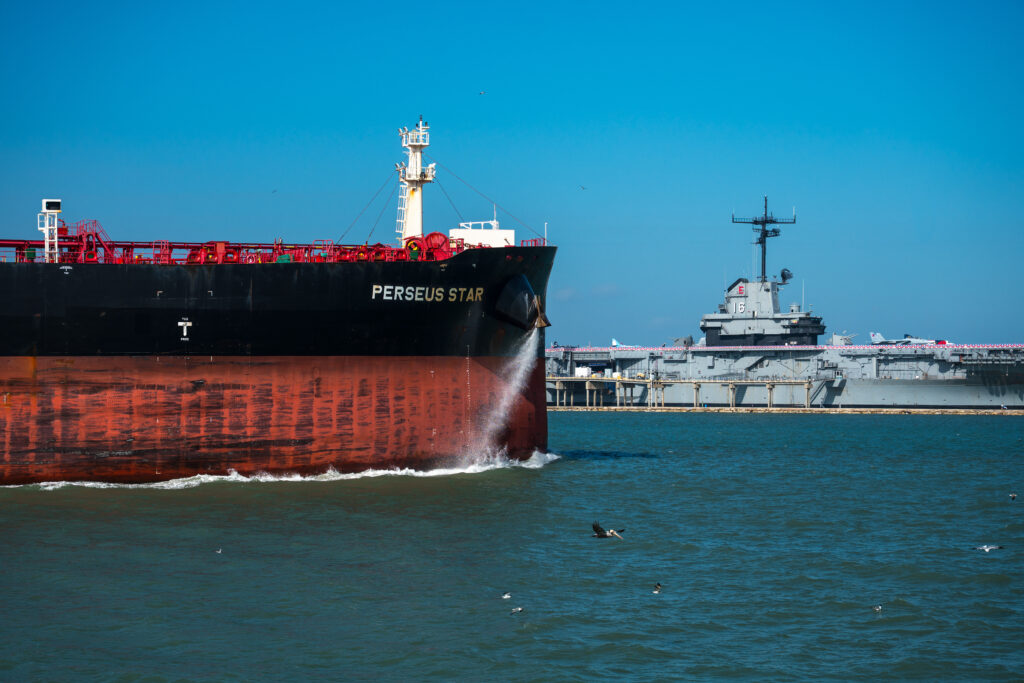
The bond rout reflects anxiety about the global economy after crude oil surged toward $120 a barrel, up almost 80% since the Iran war began and disrupted shipments from the Middle East. Sustained price increases could force central banks to keep policy tight to curb inflation even as growth slows, leaving the world grappling with stagflation.
Inflation fears have led traders to scale back expectations for the Federal Reserve’s next quarter-point rate cut to September. At the end of February, before the war erupted, traders had fully priced in a move by July. Some bond options traders are now betting the Fed may not cut rates at all this year.
Bond markets are likely to remain “under downward pressure until we see oil prices stabilize,” said Rajeev de Mello, a global macro portfolio manager at Gama Asset Management. While crude at $80 was manageable for investors, “acceleration above $100 has shocked” them and revived concerns about an inflation surge, he said.
ADVERTISEMENT
CONTINUE READING BELOW
ADVERTISEMENT:
CONTINUE READING BELOW
The economic toll would be significant. A 10% rise in energy costs that persists for a year would lift global inflation by about 0.4 percentage points and shave up to 0.2 percentage points off growth, according to International Monetary Fund managing director Kristalina Georgieva. Bloomberg Intelligence says demand destruction tends to set in when crude hits $133, highlighting the risks if prices continue to climb.
In the US, recent data have added to concerns about a potential stagflationary mix. Employers unexpectedly cut jobs in February and the unemployment rate edged higher, pointing to lingering cracks in the labor market just as price pressures intensify.
“Oil is arguably the single most important input into global inflation,” said Tim Murray, a capital market strategist in the Multi-Asset Division at T. Rowe Price. With most Asian economies significant net oil importers, that creates a “relative headwind for the region in a risk-off environment,” he added.
Bonds fell across Asia, with benchmark yields climbing by double-digit figures in Australia, New Zealand and South Korea. Indonesian and Japanese debt markets also slumped, while European bond futures retreated.
Chinese government bonds declined as well, with 30-year bond futures posting their biggest drop of the year. The asset had initially outperformed global peers after the Iran war began, but confidence in its resilience is being eroded by fears of imported inflation as oil prices push higher.
© 2026 Bloomberg
#Global #bond #selloff #deepens #oil #jump #stokes #stagflation #fear