
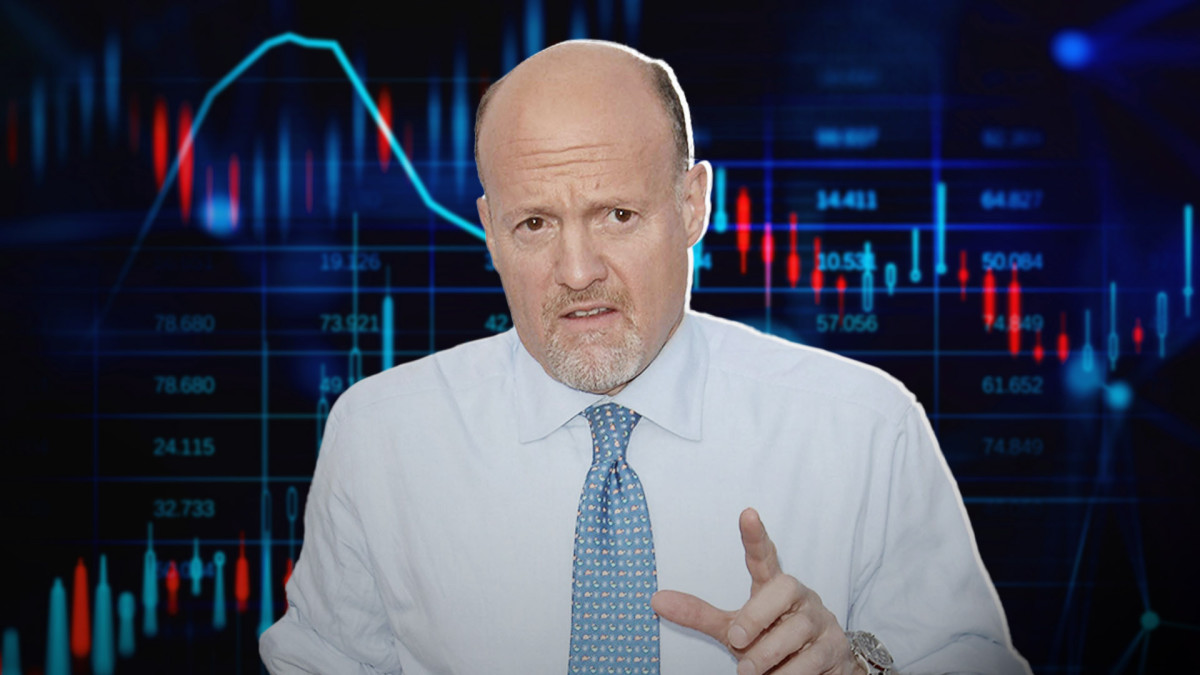
Jim Cramer is not mincing words. With the Strait of Hormuz effectively closed following U.S. and Israeli strikes on Iran, the “Mad Money” host is warning investors that an oil price shock of $150 to $200 a barrel is now a real possibility.
In his Sunday CNBC column, Cramer drew a direct parallel to Russia’s invasion of Ukraine in 2022, when Brent crude surged from around $95 to $139 in a matter of weeks on fears of losing roughly 7 million barrels per day of Russian supply.
His warning this time is starker. The Strait of Hormuz carries far more oil than Russia ever exported.
Why this oil shock could dwarf 2022
The math is the problem. Kpler data show that roughly 13 million barrels per day moved through the strait in 2025, representing about 31% of all seaborne crude flows globally.
That is nearly double the Russian supply that rattled markets in 2022. Cramer’s logic is straightforward: If losing 7 million barrels pushed Brent to $139, losing double that could push prices into territory markets have never seen.
“If oil could spike from $90 to $139 in a few weeks in 2022 on a loss of 7 million barrels, it could go up a lot more on a loss of double that amount,” Cramer wrote in his Sunday piece.
Here is what’s actually happening at the Strait of Hormuz
The situation on the water is serious.
An Islamic Revolutionary Guard Corps (IRGC) commander confirmed on March 2 that the strait was closed, warning that any vessel attempting to pass would be targeted, Al Jazeera reported.
More Oil and Gas:
- Energy giant sends blunt $20 billion message on dividend growth
- 147-year-old oil giant just raised dividend 4% in 2026
- Top energy stocks to buy amid Venezuela chaos
At least five tankers have been damaged, two crew members killed, and about 150 ships are stranded outside the waterway.
Major shipping firms, including Maersk, CMA CGM, and Hapag-Lloyd, have all suspended transits.
Qatar also halted liquefied natural gas production after Iranian drone strikes hit its facilities at Ras Laffan and Mesaieed, threatening roughly 20% of global LNG supply.
Key disruptions hitting global energy markets
- Tanker traffic through the strait dropped roughly 70% before falling to near zero.
- Brent crude has risen about 10% since the conflict began, touching near $83 per barrel.
- European natural gas futures jumped around 30% following the Qatar facility strikes.
- LNG tanker freight rates surged more than 40% in a single session.
Cramer’s advice on oil stocks: stay in, brace for pain
Despite the alarm in his tone, Cramer is not telling investors to run. He is urging them to hold positions and prepare for pain before the eventual recovery.
His core argument is that extreme oil prices are self-defeating. At $150 or $200 a barrel, demand destruction kicks in quickly. Prices come back down, and when they do, the equity rebound tends to be fast and punishing for anyone who stepped out.
“If you get out of the stock market, I can promise you that you will be left behind by the rally that comes from lower rates and lower oil,” Cramer wrote. He urged investors to steel themselves rather than flee.
TheStreet/Shutterstock
A split signal from energy stocks
Earlier in the week, on March 4, Cramer flagged a signal that briefly offered some hope. Despite the Hormuz crisis, major energy stocks were actually falling rather than surging.
On “Mad Money,” Cramer noted that Exxon Mobil, ConocoPhillips, and Halliburton (HAL) were all down 1%-2%, even as crude climbed. He compared it to 1991, when oil plunged the moment Operation Desert Storm began because markets had already priced in the worst outcome.
By Sunday, March 8, however, his tone had darkened. Cramer said he would not be surprised if oil climbed even further, noting that shipping companies may continue refusing Hormuz transits, even with the Trump administration’s $20 billion tanker reinsurance program in place.
The U.S. strategic petroleum reserve problem
One factor Cramer flagged as a compounding concern is the depleted state of the U.S. Strategic Petroleum Reserve. President Joe Biden drew it down significantly in 2022 to blunt that year’s oil surge. It has not been fully replenished since.
Cramer noted that President Donald Trump has downplayed the need to tap the reserve this time around. That leaves the U.S. with a smaller cushion than it had in 2022, limiting one of the key tools available to cool a price shock quickly.
The bottom line on the Hormuz closure
Cramer’s message is not a comfortable one. A sustained Hormuz closure is unlike anything modern markets have fully dealt with, and the $150 to $200 price range he is flagging is no longer a fringe scenario.
His advice is to expect the sell-off, absorb it, and stay the course for the recovery that follows when the strait eventually reopens. The only real question, as he put it, is how long that takes.
Related: Energy stocks jump as Goldman Sachs warns of potential ‘doubling’
#Jim #Cramer #sounds #alarm #energy #stocks