
Supercars aren’t always super to drive.
I’ve been at racetracks only too happy to exit the vehicles in question, politely declining a last lap or two. Too raw, too unpredictable, too thinly appointed? I’m out after a few rounds. It’s those last laps when your nerves are frayed and your focus shaky that you run into trouble. Making a mistake at 140 mph and going into a wall is a risk that doesn’t outweigh the reward of driving such a car for one more loop.
News flash: I’m not a professional race car driver. Give me a supercar with elegance at any speed, something that makes me feel like a better driver than I actually am. Consistency, comfort and control? Count me in. Does that make me a normie? So be it.
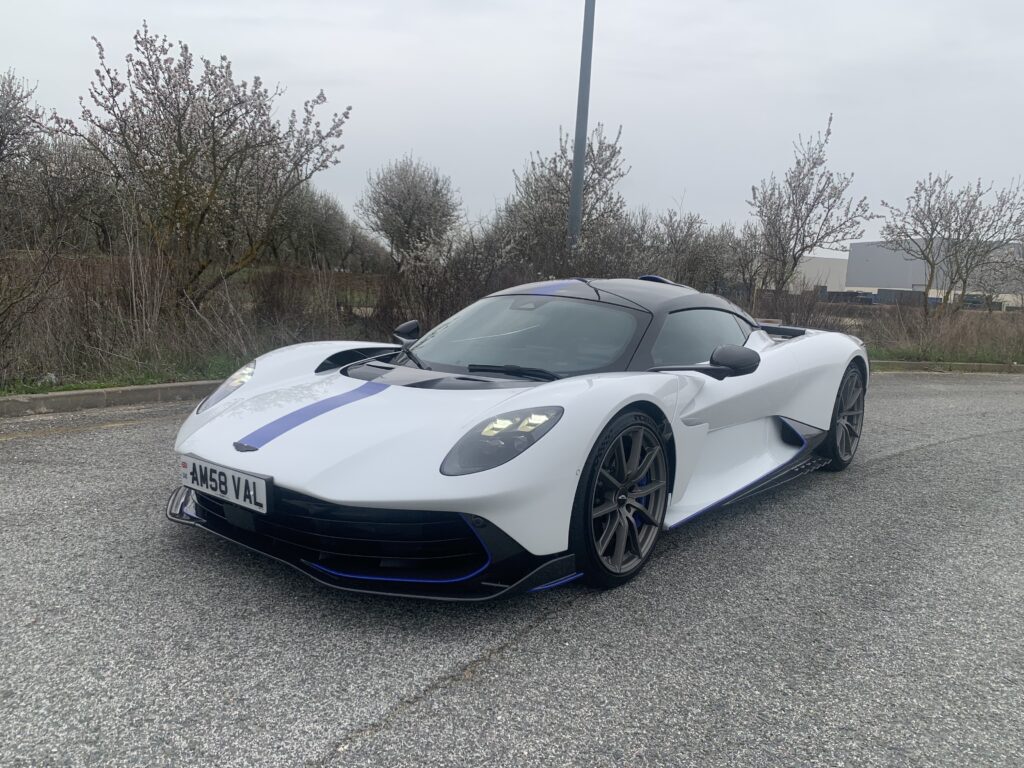
I was only too eager to stay in the driver’s seat of Aston Martin’s $1,051,500 Valhalla earlier this month in Spain. With its towering spoiler and gaping air vents, this new plug-in hybrid looks like an intergalactic insect ready to devour anything in its path. At 1,064 horsepower with a top speed of 217 mph, it’s got the mind-melting performance to back it up.
But the feeling inside the cockpit is far less intimidating. Valhalla is easy and fun to drive at any speed — a pussycat with a quiet cabin, four drive modes and handling so finessed I was as happy to drive it on the rural byways of San Sebastian, Spain, as on the Circuito de Navarra racetrack. Maybe more.
In today’s supercar market, owners love flaunting their rare, extreme car that no one else can get. Seven-figure price tag and 1,000-plus hp? These days they’re practically de rigueur.
ADVERTISEMENT
CONTINUE READING BELOW
The Valhalla completes Aston Martin’s lineup, filling a previously untapped gap between the $262,000 DB12 sports car and the $3 million Valkyrie hypercar. It’s attracting plenty of newcomers, the company’s Chief Executive Officer Adrian Hallmark says: 70% of Valhalla buyers are first-time Aston Martin owners. With 152 of its total 999 units already delivered and 500 more to be delivered in 2026, it belongs to a growing segment: million-dollar supercars purchased by those as likely to take them to casual cars-and-coffee meetups in their neighbourhood as any racetrack.
When drivability became cool
Normal is a relative word, of course, and anyone who can afford a Valhalla is by definition not your average Joe. In Spain, Hallmark told me most buyers end up adding lots of custom details to their Valhallas, which has pushed the median price to around $1.6 million. But a handful of entries in recent years have made this segment so well recognised that it can almost feel crowded.
Ten years ago, 700 hp and six-figure prices were enough to make a car feel special. Today, that doesn’t cut it. Automakers are meeting a demand for something of a sweet spot between a regular sports car like a Porsche 911 Carrera and a hypercar like the Koenigsegg Jesko. The first has almost 400 hp. The second has 1,600.
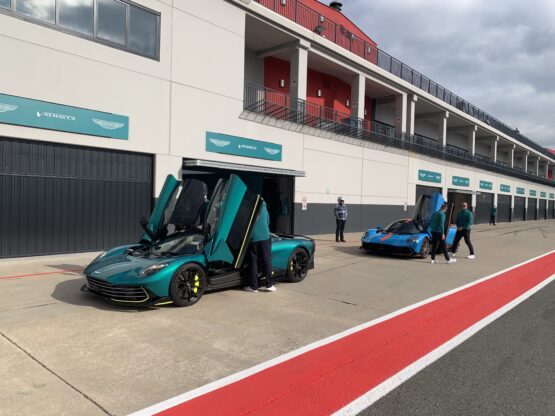
The Valhalla has an all-new eight-speed dual-clutch transmission with paddle shifting, a gearbox developed specifically for what Aston calls its hybrid era. Photographer: Hannah Elliott/Bloomberg
“The market is very tight,” says Stephan Winkelmann, president and CEO of Lamborghini. He told me he estimates the appetite for supercars — small but stable amid the broader chaos in automotive right now — sits at roughly 45 000 units worldwide.
How did we get here? It started in 2013, with a holy trinity of plug-in supercars. Ferrari introduced the La Ferrari, a 950-hp hybrid with a list price of about $1.4 million. McLaren introduced the P1, a 904-hp hybrid that cost around $1.1 million. Porsche unveiled the 918 Spyder, a 887-hp hybrid that costs nearly $1 million with upgrades.
ADVERTISEMENT:
CONTINUE READING BELOW
Those models were revelations, proving that hybrid power could be fast and sexy, not just efficient. They have all gained significant value on the collector market since their debut, bolstering their benchmark status.
Key to their success, in addition to design and performance acumen, was their unprecedented drivability — automatic transmissions that made them de facto more practical than their precursors. The 918 Spyder was far easier to drive than its predecessor, the Carrera GT, which had a reputation for having a hair-trigger clutch and a penchant for getting unruly.
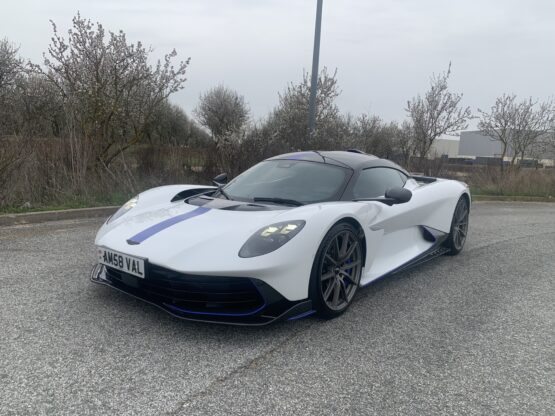
In pure EV mode, the car has a range of 14 km (8.6 miles) and a top speed limited to 140 km/h. Image: Hannah Elliott/Bloomberg
More than a decade later, it’s notable that Porsche brass have indicated that they’re considering a follow-up. On March 11, Porsche CEO Michael Leiters made headlines when he hinted the company is working to develop a new supercar. I expect it’ll fit quite comfortably in this segment.
A crowded field
Anyone looking to spend around seven figures has plenty of options, from the McLaren Elva to the Lamborghini Revuelto. Ferrari, the uncontested leader in this department, makes several, including the 1,016-hp SF90 XX Stradale.
ADVERTISEMENT:
CONTINUE READING BELOW
The Valhalla adds another option for more buyers eager to flex. Its production run of nearly 1,000 is downright abundant compared with the scarcer Aston Martin Valkyrie, with its 150 coupes and 85 spyders, or the Aston Martin Valour, limited to 110. (It’s not sold out yet. An Aston Martin spokesperson says it should be by the end of this summer.)
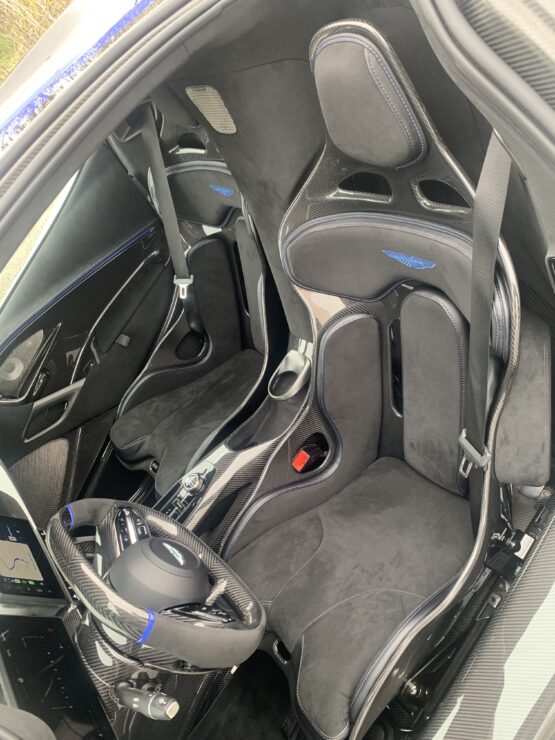
The dihedral doors that open up and out allow drivers to easily drop into the bespoke carbon fibre seats and swing their legs into the cabin underneath the flattened steering wheel. Image: Hannah Elliott/Bloomberg
Let me be clear: This is no grocery-getter. It gets to 62 mph in 2.5 seconds. (I reached 145 mph on the front straight at Navarra and highly recommend it.) It has no trunk and about as much rear visibility as a cargo van. You must push a button that lifts the front if you want to attempt an incline in a driveway or a parking lot. Its hidden door handles are tiny buttons located inconveniently underneath the long, swooping curve of the car’s side body. Its small touchscreens feel outdated, almost aftermarket.
But these are mere quibbles. These cars are a far cry from the foreboding personalities of their forerunners, whose heavy clutches, searing and screaming engines, next-to-nil visibility and heavy steering required herculean muscle to manage. Only experienced drivers could control them. Comparisons to high-octane farm equipment were not unfair.
By contrast, Valhalla is composed, with minimal road noise and a responsive chassis that almost coddles. Its rear-wheel steering and Formula One-calibrated suspension anticipate road undulations with the vigilance of a German shepherd. Rather than creating anxiety and stress about commanding such a machine, the Valhalla makes driving a delight. Back at that windy gray track in Spain, I took all the seat time I could get.
© 2026 Bloomberg
#wheel #Aston #Martins #supercar #normies